

Two Things Can Be True
Sometimes we just need to be direct and get shit done.


A client and I were recently discussing her interactions with teammates who, to be honest, sound like they were legitimate nightmares to work with. Unfortunately, just agreeing with that assessment and having a good laugh doesn’t make a good coaching session. I had to help her find a way to work with them, and come out of it with her side of the street clean. Which is a funny thing to say, considering I spent a number of years doing the exact opposite myself (but more on that later).
My goal for this session was to find a way to help her thread the needle of personalization/depersonalization. As with most things at work there’s a balance to be struck:
Personalization: Your coworkers are human, they are flawed, they are frail, and they have every intention of doing a good job. So we need to see them as humans and treat them as such.
Depersonalization: Your coworkers have their own opinions and beliefs, and sometimes they’re just completely shit. Sure their biases can be based in ignorance, but that doesn’t make up for the fact that they might not view you as an equal to them based on something that is out of your control. So we need to ignore that they are human and treat them as work machines, ignoring the non-work related parts of them.
This might sound confusing, but as my therapist reminds me 28 times per session, “Two things can be true”.
The reality is that at work, your goal is for everyone to like working with you, and at a bare minimum, they should _believe_ that you like working with them. Yes that includes the tech bro failed entrepreneur who spends too much time staring at himself in the mirror, the coworker who is constantly inviting their toddler to join them during zoom meetings, and..... ugh.... the MAGA coworker who still won’t tell you why they took off work a few January’s ago.
Because at work, every decision we make, every strategy we employ, needs to support the Three Pillars.
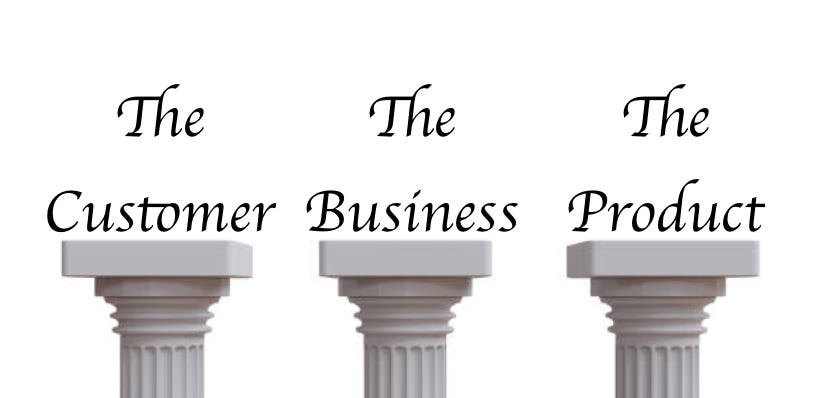
I posit that every decision we make needs to support these three pillars, and these three alone. Not all decisions will support all three equally, but if we fully diminish the integrity of any of them, everything will crumble. I can elaborate on this in a further post, but the bottom line is, these three pillars are stronger and more important than any one employee.
If we focus on these three goals, it can be easier to look at our coworkers (and frankly, ourselves) as machines in a factory. This sentence probably has you panicking, wanting to scream “I’m a human not a machine!”
But honestly? Sometimes there’s a decision to be made that completely goes against what you believe in as a human. Working at cosmetics companies and being told “We’re exploring BNPL (Buy Now Pay Later)” was one of those moments for me. I didn’t want to take money from someone who didn’t have it for something they didn’t need. I didn’t want to send an 18 year old to debt collectors for something they saw on Instagram and just HAD TO HAVE. But the companies I was at were struggling, and it didn’t serve any of those pillars if we demurred. So I turned off human mode, and turned on machine mode.
“Ok, I understand. What do we need to do to make this happen.”
This is called “disagree and commit”. It’s also called “just fucking do it, because this is what we’re doing, and the more you push back the worse it’s going to be for your career here.” Does that suck? Of course. Is it also just the way of the world? Yup.
Two things can be true.
And no, BNPL was not the savior that some PMs thought it would be. Not for either of the companies where this came up. One company thankfully decided against it, the other embraced it- and just had their second wave of mass layoffs a week ago. But that’s not the point. Both times, my disagreement was noted, as well as my willingness to execute in spit of it. **If you don’t like a decision that is made, you have to decide if it’s a deal breaker or you’re going to drop it and move forward**. There’s no other option. Nobody wants an employee who shuffles their feet through executing on a task.
So for my client, I needed to give her a path forward. She doesn’t like these people and doesn’t want to be besties with them, but she’s their tech lead. And they’re probably talking shit about her in their DMs or to their friends, but she’s still their tech lead. My technique for dealing with this is to put a solid target right in the eye of that needle and hit it.
The way you do that is to pull the person you’re not vibing with aside and say, verbatim:
“We’re not vibing. Do you agree?”

It’s disarming. It’s direct. It’s... actually, about as human as it gets. When they slowly nod and agree, you follow up with:
“We should be vibing, and honestly I don’t know why we aren’t vibing. So what do you say we just commit to vibing?”
(Note: if you’re reading this in the future, first off, sick. Secondly, use whatever word has replaced “vibing”. I bet it’s going to be something dumb like “zerking” or “flumping”.)
I’ll be honest, I’ve done this multiple times and it always works. It’s not beating around the bush, it’s not politics, it’s just 1:1 direct “let’s just get along and make money together, even if we don’t want to.”
I learned this technique early (but not early enough) in my career. After a few years of going to war with everyone who so much as put too many comments on my PRs, I was run down. My technical skills kept growing but my social capital well runneth dry because I was an asshole. Someone a few years younger than me joined my team and I immediately hated him. Was it because he was taller than me, more conventionally attractive than me, had more friends than me, his release notes got more applause than mine? Yea, probably. Like I said, I was an asshole. But no, I didn’t have any legitimate reason to dislike him.
All of our interactions were tense. To be fair, he didn’t seem to like me much either. On paper he and I probably should have been friends, but there was some little grain of sand in the way that caused just enough friction. And because this unnameable grain of sand was so tiny and imperceptible, it just kept going and going.
Until I came into the office, and saw him sitting at his desk. Nobody else around as he was working late, and honestly I don’t know what came over me but I decided in that moment that I was going to try something.
I pulled him aside and said the words above. I apologized, he apologized, we shook hands, and true story we actually became pretty good friends after that. Did I still agree with everything he said in design sessions? No. Did I sometimes disagree and commit because it would get us closer to hands-on-the-keyboard execution? Yes.
Because at the end of the day, two things can be true.
